June 26, 2012

Gyöngy Laky now at DZINE


DZINE in collaboration with Cain Schulte Contemporary Art is pleased to present Gyöngy Laky.


Gyöngy Laky presents a series of work examining our complex relationship with nature.  Sculptural vessels are made of painted and stained branches and twigs combined with screws, nails, and wires.  The organic essence of the natural wood contrasted with the spiky industrial elements draws upon the ambivalence of the natural and artificial, organic and industrial, and encapsulates co-existing feelings of violence and serenity, aggression and sanctuary.


Born in Budapest, Hungary, in 1944, Gyöngy Laky studied at UC Berkeley where she earned both her B.A. and M.A. degrees (B.A., 1970 and M.A., 1971). She has exhibited in museums and galleries throughout the United States and internationally in France, Sweden, Italy, Spain, Denmark, Holland, Switzerland, Hungary, Lithuania, Colombia, the Philippines, China, and England.


A past recipient of a National Endowment for the Arts Fellowship, and a Professor Emeritus at the University of California, Davis, Laky’s work is in museum collections in Europe and the United States, including the San Francisco MOMA, The Smithsonian’s Renwick Museum of American Art, the Philadelphia Museum of Art, the Oakland Museum, and the Contemporary Museum in Honolulu.


An artist, academic and activist (all encouraged during studies at UC Berkeley), I engage subjects of particular and on-going concern to me using hand constructions as my primary vehicle of expression. I build pieces in the architectural spectrum. Environmental concerns are obvious in my sculptures and temporary site-specific works composed of orchard, park and street tree prunings from the tons of debris available as growers and gardeners trim and dump (or burn). With these exquisite hardwoods, I play with the question, “What is waste?” What is, and is not, garbage or is considered useless, is both intriguing and problematic. The specific choices I make selecting materials and structuring forms allow me to experiment with intent and attitude, extending and altering possible responses. The juxtapositions of screws and branches or toothpicks and charcoal, address the edgy relationships and flux of human interactions with nature. With language works, incorporating words and/or signs, I borrow from the concrete poets and their visual poetry -- that physical attributes, pattern or arrangement enhances meaning. Transforming wall works and basketry into vessels for meaning lends itself to associating pieces with issues beyond just my worry about the rising threat to our environment. The word/symbol works, particularly, have allowed me to present more strongly the activist part of my life associated with such concerns as gender equity, diversity, economic upheaval and, after March of 2003, with my opposition to militarism and our wasteful and tragic wars. I support the Occupy Wall Street movement.


Below are more of Gyöngy Laky's works.


Gyöngy Laky working in her studio on her words collection piece "NO".


To check out her website go here.

June 22, 2012

Maarten chair by Victor Carrasco


The 'Maarten' chair designed by Spanish designer Victor Carrasco, for the furniture manufacturer Viccarbe, was designed as a tribute to the late Belgian designer Maarten van Severen. 


This swivel chair was designed for both the home and for public spaces.  It's lacquered steel tube structure and carefully made, elegant, upholstered seat recall the classics of the '70's.

'Maarten' is available in a large range of finishes to adapt to different environments.


The 'Maarten' chair premiered at this years Salone del Mobile.


June 15, 2012

New Window Display at DZINE

Published on dwell.com

June 01–September 09
Dzine, 128 Utah Street, San Francisco, California


If you find yourself in the San Francisco design district be sure to stop by DZINE, where a new display by Gensler featuring the FLOS Minikelvin lamp is brightening its storefront. The display is entitled "Light, Liberty, and the Pursuit of Happiness" and features cutouts of an elephant and donkey surrounded by a heart-shaped series of the Antonio Citterio–designed lamps in what Collin Burry, Principal at Gensler, describes as "a big bipartisan smooch." In addition to the Minikelvin, DZINE stocks the Piani, D’E-Light, and Miniteca by FLOS.

More info: dzinestore.com

You can find the original article here.

June 12, 2012

Gensler SF Curates FLOS Window Display at DZINE

officenewswire


5.30.12 | San Francisco, CA | DZINE, San Francisco’s leading retailer of high-end, modern furniture, is pleased to announce a new window display curated by Gensler SF in the FLOS section of the showroom. Collin Burry, Principal at Gensler SF, led the team and selected FLOS’s new Minikelvin LED lamp, designed by Antonio Citterio, for the display entitled “Light, Liberty and the Pursuit of Happiness.” The design represents the political ideal of the Republican and Democratic parties working together to lead the country more efficiently.


“DZINE, FLOS and Gensler help put the symbols of the political parties, elephant and donkey, head to head in a big ol’ bipartisan smooch,” said Burry. “What better way to illuminate this lovely union than a heart of Minikelvins, a light source for all no matter your affiliation.”

The Minikelvin LED lamp is a pint-sized version of FLOS’s best-selling Kelvin LED lamp by Antonio Citterio. Featuring all of the technologically advanced aspects of its predecessor, the Kelvin LED, including an on/off switch with Soft Touch technology (touch sensor), light flow adjustment to 2 intensities (100%, 50% and 0%), an adjustable head and a fused aluminum alloy body in chrome, this mini version has an arm length of 11.81” and weighs just 1.76 lbs.


“We are thrilled to have Collin Burry and the Gensler SF team contribute this latest design to the FLOS window, incorporating FLOS’s Minikelvin LED lamp,” said Cardenio Petrucci, Co-owner of DZINE. “Gensler selected a very apropos theme for the display, which will be debuted prior to the anticipation of the presidential election.”

DZINE will unveil the new window display at a private event on Wednesday, May 30th, 2012 from 5:30-6:30 pm at their showroom (128 Utah St., at Alameda St.). Burry and other Gensler SF team members will be on hand at the event to answer any questions about the display.


Gensler SF team in front of their window display entitled “Light, Liberty and the Pursuit of Happiness.”


FLOS opened its San Francisco store inside the DZINE showroom in November 2011 with FLOS classics such as Arco, Taraxacum and Toio by Castiglioni, as well as new favorites such as the elegant Wallpiercing, part of the Soft Architecture line, the simplistic Lightspring and La Linea, and the inventive Miniteca table lamp, all designed by Gilad; the Ktribe by Philippe Starck; Glo-Ball by Jasper Morrison; Skygarden and Zeppelin suspension lamps by Marcel Wanders and, of course, Antonio Citterio’s Kelvin LED and Minikelvin LED lamps. The initial FLOS window display featured the Piani lamp by Ronan and Erwan Bouroullec and was designed by renowned interior designer Nicole Hollis.

Read original article here.

June 8, 2012

Shigeru Ban - 10-Unit System


Shigeru Ban, born in 1957 in Tokyo, Japan, is an internationally recognized Japanese architect. He has been a pioneer in applying the principles of sustainable development to architectural design. Shigeru Ban’s architecture emphasises refinement and a highly developed innovativeness, especially in materials technologies. His original and bold approach to the use of paper, cardboard and bamboo as construction materials, combined with a clean-lined and contemporary architectural aesthetic, has made him one of the most important architects of our time.


Artek New York (2009)


Shigeru Ban studied at the Southern California Institute of Architecture and later on in the Cooper Union’s School of Architecture. Ban graduated in 1984 after which he started his own practice in 1985.


Artek in Milan (2009)


Shigeru Ban can be described as a modernist, experimentalist as well as a rationalist. The architect is most famous for his innovative work with paper tubes as a material for building construction. Ban’s architecture has strong influences from his interest in humanitarianism. Shigeru Ban is concerned with building as a whole, and is not interested only in so-called beautiful architecture: providing assistance in coping with catastrophes is just as important to him. Shigeru Ban’s DIY Refugee shelters (used for example in Japan after the Kobe earthquake, in Turkey and in Rwanda) have proved very effective for disaster relief housing. Ban knows that simple solutions are often the most difficult to develop –especially when using inexpensive materials.

Shigeru Ban’s major works include among many other things the Japanese Pavilion at the Hannover Expo 2000 and the new Centre Georges Pompidou in Metz, which is expected to be completed in 2009. In 2007, Shigeru Ban designed the Artek Pavilion, “The Space of Silence”, for the Salone del Mobile. Ban’s 10-UNIT SYSTEM for Artek is launched in Milan 2009.


Artek in Miami (2009)


The 10-Unit System is comprised of 10 wood plastic composite L-shaped units. The 10 L-units in a system can be used to assemble several items, including a chair, a stool and a frame for a table. By combining more L-units you are able to create new furniture pieces, such as benches.


June 5, 2012

Kartell Work In Project - Video story from Salone 2012

The below video features Kartell's display at this years Salone del Mobile. The theme for their display focuses on explaining the culture of the Kartell project through the development and evolution of their products. A number of Kartell's collaborating designers discuss their ideas behind the new products introduced at the Salone del Mobile and their process with Kartell from project to product.


May 25, 2012

Ilmari Tapiovaara Designs Part of Artek Product Range


In 2010 the products of Ilmari Tapiovaara became part of the Artek product range.  The manufacturing facility where llmari Tapiovaara pieces were being produced had been failing. Artek saw this as an opportunity, in purchasing the facility, to keep the furniture pieces in production and promote them to a wider audience than before.  The Ilmari Tapiovaara pieces added to their existing collection mainly designed by their founders Alvar and Aino Aalto, Maire Gullichsen and Nils-Gustav Hahl.


Ilmari Tapiovaara was one of the greatest interior architects and designers of his era. With the mind of an explorer and a soul of a craftsman, Tapiovaara was always seeking for new solutions to improve everyday objects. During his long career Tapiovaara created dozens of iconic objects loved by the public.


Domus Lounge chair - Ilmari Tapiovaara (1946)


Domus chair - Ilmari Tapiovaara (1946)


Tapiovaara is especially revered as a master of characteristic and human objects and surroundings who captured the essence of Finnish identity. Today the contemporary Tapiovaara Family Collection maintains the timeless heritage of a master of Finnish design. Ilmari Tapiovaara graduated in 1937 as interior architect from the department of furniture design of the Central School of Applied Arts in Helsinki. After graduation he obtained the position of assistant for six months at Le Corbusier’s office in Paris. In 1938 Tapiovaara began work as artistic director and designer at Asko Oy, the largest furniture manufacturer in Finland, and in 1941 he was hired as artistic and commercial director for the furniture company Keravan Puuteollisuus Oy. In 1946–47 Tapiovaara designed, together with his wife, Annikki Tapiovaara, furniture for Domus Academica, the new student housing facility in Helsinki. It was in that project the famous Domus Stacking Chair was designed.


Mademoiselle Lounge Chair - Ilmari Tapiovaara (1956)


Tee-Tee Table - Ilmari Tapiovaara (1940)


Ilmari Tapiovaara was a great admirer of Alvar Aalto’s work, and he wanted to create products based on the same ideological premises. Tapiovaara embraced the principle of social equality of functionalism, and felt that architecture was the starting point of his design work. In addition to dozens of chairs and other furniture, mostly intended for public spaces, Tapiovaara also designed interiors for many banks, offices, hotels and showrooms starting in the 1940s.


Pirkka collection - Ilmari Tapiovaara (1955)


Ilmari Tapiovaara also worked abroad in various capacities. In 1952–53 he was employed as professor at the school of design of the Illinois Institute of Technology in Chicago, and he also worked for a while in the office of Mies van der Rohe. In the late 1950s, he travelled to Paraguay, where he designed furniture on behalf of the UN development program, and in the mid-1970s he worked in Mauritius in a similar project. He also worked in an expert capacity in Yugoslavia, participating in the development of a centre for furniture and joinery industry. He also designed furniture for clients in Italy and Sweden, among others.


Trienna Table - Ilmari Tapiovaara (1954)


Ilmari Tapiovaara furniture collection for Artek


Ilmari Tapiovaara was awarded a total of six gold medals at the Milan Triennials in 1951, 1954, 1957, 1960 and 1964. He was awarded the Good Design Award in Chicago in 1951, the Pro Finlandia medal in 1959, the Finnish State Design Prize in 1971 and the Furniture Prize of the SIO Interior Architects’ Association of Finland in 1990.


Kiki collection - Ilmari Tapiovaara (1960)


May 21, 2012

New Products Presented by Porro

Among the most looked-for furnishing brands on the market, Porro stands out for its essential and immediately identified language, with simple signs, geometries, shapes, without forgetting in case of highly complex production processing too, its unique company philosophy: simplicity.

All Porro products are the result of a subtraction, form a progressive simplification process. Systems which are complex too, are the result of a very simple aesthetic vision, based on consistency, simplification, simplicity, without forgetting quality, the best possible quality at all.

In the recent years, Porro has collaborated with International designers such as Jean Marie Massaud, Christophe Pillet and the Swedish group, Front.

This year at the Salone del Mobile Porro introduced a few new pieces but also reinvented some of their already established pieces from their furniture collection.


The new Chameleon unit, designed by Front, is a magic volume, opening on itself as a Chinese box game, changing appearance and revealing new finishes. To be used as a bedroom unit or to furnish the living room, it consists of a pear-wood crate, a soft wood in a delicate rose color, customized with drawers and shelves and covered with precious leathers, used as a hinge, allow to turn it and changed into a luggage or a bag, to change its color and look - from white to black - according to your mood.


Piero Lissoni designed a new accessory for the Porro Collection: the Tiller sideboard, available in two models, vertically developed on 1.6 meters wide and horizontally developed on 2.2 meters wide, shows 4 doors can be opened one on the other pleasantly changing the front design appearance. Raised on 4 matte black metal feet from the floor, Tiller proves once more the technical expertise of a brand able to test year after year new opening mechanisms and technologies. Structure in Eucalypt wood, inner drawers on demand.


The new design to enter into the Porro table collection is the new extension table, Taac, by the young Italian designer Michele Cazzaniga, whose top can extend form a minimum of 190cm to 300cm wide, and is 95cm deep. A project simply translating the practical requirement of the new shapes, materials and technical solutions: in Eucalypt, a dark wood, extremely consistent and richly shaded, barely displaying the internal black aluminum frame.


Stolen form a fairy tale, directly coming from a children's book, the result of any dream coming true, the Gentle chair entirely reinterprets the seat archetype, making its shapes far more modern and purified. If at a first glance it looks like a continuum, a pattern drawing drafted without moving the pencil from the paper, in reality it perfectly hides a complex project, matching metal covered by soft leather at the back legs level, moving up to the back arch, to the light wood of the front legs, becoming the arm and back supports, in a subtle opposite contrast. The soft back and the leather upholstered seat make the chair "soft" at the touch and at sight, in a harmonic double-colored optical effect, graphical and retro at the same time, always two colors perfectly and elegantly matched.


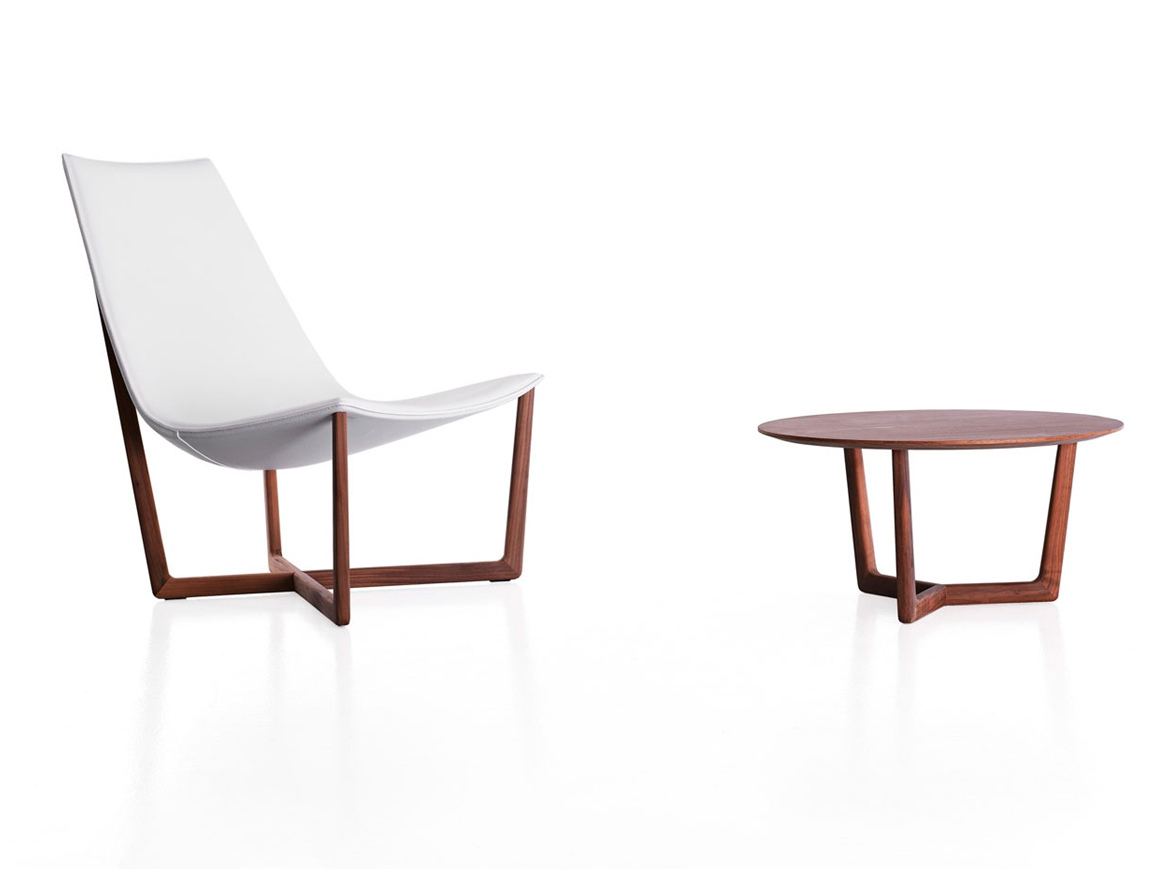
The Jade designed by Christophe Pillet was reintroduced this year in a new finish, canaletto walnut.  Its harmonious lines and relaxed posture distinguish the Jade lounge armchair: presented by Porro in leather or eco-leather it appears to be suspended on the structure with cross base, supported at four points.


A new round version for the Synapsis table, designed by Jean Marie Massaud, was added this year to compliment the original design of the oval table with cut ends version. The innovation of this item is represented by the bearing element: a plated, white or black steel wire grille that has been emptied and transformed in a web of welded pipes. The base looks very light when coupled with the light top. The oval version is available in Pral, in all the lacquered colors of the sample collection, white or black high resistant matte lacquered, in black stained hemlock or in "carbone" oak. The round version is available in Pral or in all the lacquered colors of the sample collection.